
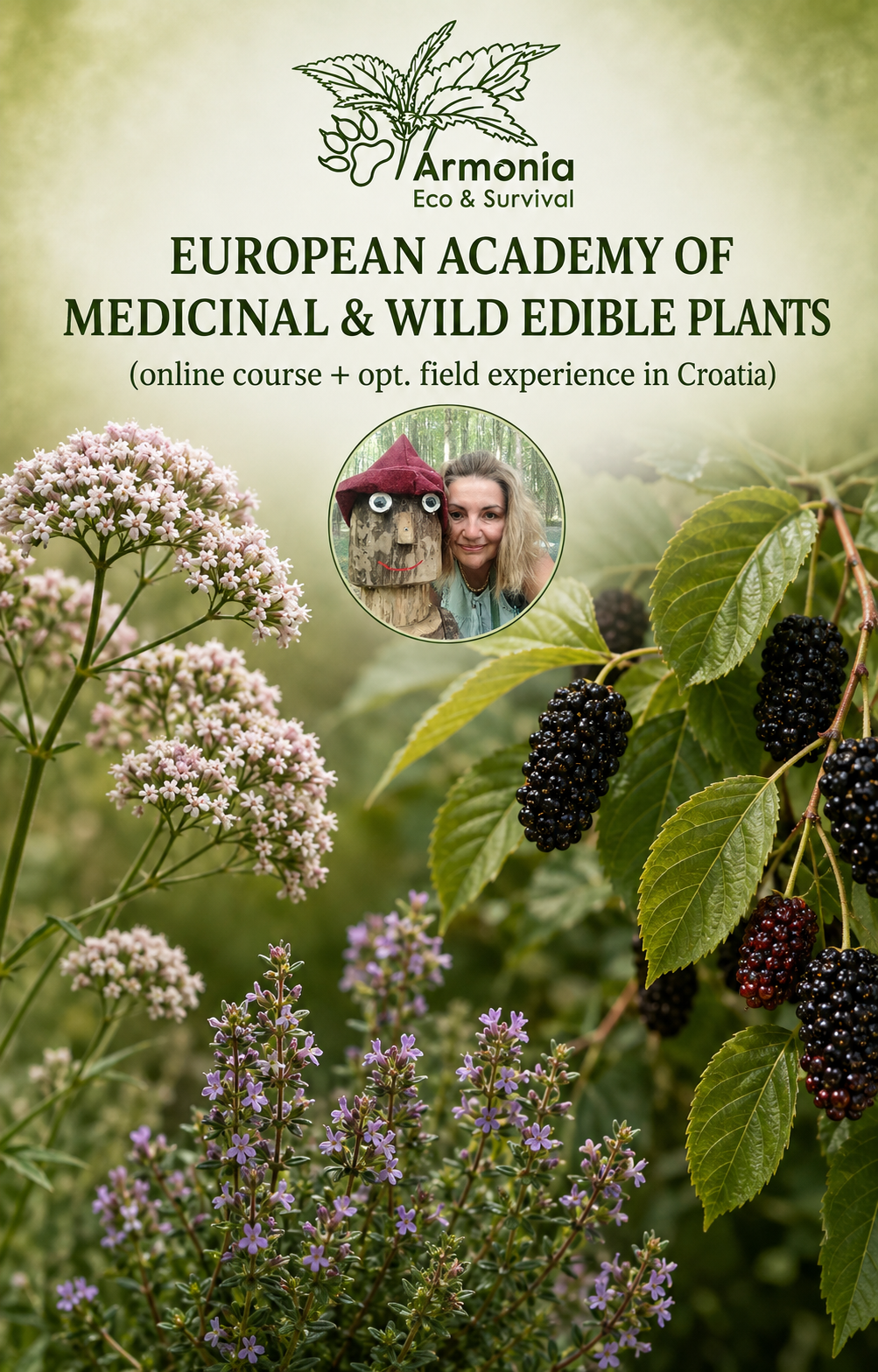
EUROPEAN ACADEMY OF MEDICINAL & WILD EDIBLE PLANTS
European Plant Knowledge — From Tradition to Modern Science
Botany · Wild Foods · Medicinal Plants · European Traditions · Ethnobotany · Phytochemistry · Herbal Preparations · Ecology
The European Academy of Medicinal & Wild Edible Plants is a non-formal online educational program designed for people who want to develop a comprehensive understanding of European medicinal and wild edible plants.
The program brings together:
- Botanical identification
- Plant ecology
- Wild food knowledge
- Medicinal plant knowledge
- Phytochemistry
- Ethnobotany
- Energetic herbalism
- European plant traditions
- Traditional herbal knowledge
- Modern clinical applications of phytotherapy
- Evidence-based phytotherapy
- Herbal safety
- Sustainable harvesting
A distinctive feature of the Academy is the integrated study of plants through both scientific and traditional perspectives. Students explore a plant’s botanical characteristics, habitat, traditional uses, sensory qualities, energetic properties, phytochemical constituents, physiological effects, preparations, safety considerations, and available scientific evidence.
The Academy introduces energetic herbalism as a traditional framework for observing and describing plants and their relationship with the human organism.
Depending on the historical tradition, students explore concepts such as:
- warming and cooling qualities
- drying and moistening qualities
- stimulating, relaxing, strengthening and dispersing qualities
- taste and sensory qualities
- traditional plant affinities
- temperament and constitutional perspectives
- plant energetics in European herbal traditions
- the relationship between plant qualities, preparation methods and traditional applications
- comparison with selected concepts from Ayurveda and Traditional Chinese Medicine
Students learn through recorded online lectures, practical video demonstrations, study materials, plant monographs, assignments, mentoring sessions and knowledge tests.
Students may additionally choose to travel to Croatia for an optional:
EUROPEAN FIELD EXPERIENCE – CROATIA
The optional field experience includes field botany, medicinal and wild edible plant identification, ethnobotany and practical herbal preparation workshops.
***
MODULE 1: BOTANY – UNDERSTANDING EUROPEAN PLANTS
Lessons
- What Is a Plant? – Introduction to Plant Biology
- Plant Morphology
- Leaves, Flowers, Fruits and Seeds
- Roots, Rhizomes, Bulbs and Other Underground Parts
- Plant Families
- Botanical Nomenclature and Taxonomy
- How to Use a Botanical Key
- Field Identification
- Dangerous Look-alikes
- Creating a Personal Herbarium
This module provides the botanical foundation required for all subsequent plant identification and fieldwork.
MODULE 2: WILD EDIBLE PLANTS OF EUROPE
Lessons
- Edible leaves
- Edible flowers
- Edible fruits
- Edible seeds
- Edible roots
- Young shoots
- Wild vegetables
- Wild spices
- Wild beverages
- Seasonal availability
- Basic principles of responsible harvesting
- Traditional preservation methods
Students learn how botanical knowledge can be applied to the identification and use of wild edible plants.
MODULE 3: MEDICINAL PLANTS OF EUROPE
Lessons
- What Is a Medicinal Plant?
- Herbal Drugs and Medicinal Plant Parts
- Selecting the Appropriate Plant Part
- Harvesting Time
- Drying
- Storage
- Quality of Herbal Raw Materials
- Factors Affecting Medicinal Plant Quality
- Introduction to Modern Phytotherapy
This module focuses on the plant as medicinal raw material, preparing students for the study of phytochemistry, physiological effects, traditional energetics and herbal preparations.
MODULE 4: EUROPEAN PLANT TRADITIONS
From Ancient Europe to Modern Herbalism
4.1 Ancient Mediterranean Europe
- Ancient Greek medicine
- Hippocrates
- Dioscorides
- De materia medica
- Galen
- Roman medicine
- Traditional descriptions of plant qualities
4.2 Celtic, Germanic and Northern European Traditions
- Plants in everyday life
- Food
- Healing
- Plant symbolism
- Relationships between plants and landscapes
- Traditional sensory and energetic perceptions of plants
4.3 Medieval Europe
- Monastic medicine
- Monastery gardens
- Medieval herbals
- Hildegard of Bingen
- Physica
- Traditional concepts of plant qualities and healing
4.4 Renaissance Europe
- Development of herbals
- Apothecaries
- Paracelsus
- Alchemy and astrology
- Signatures and symbolic approaches to plants
4.5 From Tradition to Pharmacognosy
The development of European plant knowledge from traditional herbal practice toward the foundations of modern pharmacognosy.
MODULE 5: SLAVIC PLANT TRADITIONS
The Botanical Heritage of Slavic Peoples
One of the signature modules of the Armonia Academy.
Lessons
- What Is Slavic Ethnobotany?
- Sources of Traditional Knowledge
- Oral Traditions
- Ethnographic Records
- Material Culture
- Local Ecological Knowledge
- Plants in Slavic Folk Medicine
- Traditional perceptions of plant qualities
- Plants in Seasonal Customs
- Spring Plants
- Midsummer / St. John’s Traditions
- Protective Plants
- Household Plants
- The Annual Ritual Cycle
- Sacred, Symbolic and Everyday Plants
- Myth, Folklore and Evidence
Selected culturally significant plants
- Oak
- Linden
- Birch
- Elder
- Hawthorn
- Wormwood
- Juniper
- Other culturally significant European plants
The focus is on cultural meaning, historical context, traditional plant knowledge and its transmission, including traditional perceptions of plant qualities and affinities.
Technical preparation methods are covered in Module 9.
MODULE 6: EUROPEAN ETHNOBOTANY
How Europeans Lived with Plants
Plants are explored beyond their medicinal role.
Traditional plant uses include:
- Food
- Spices
- Beverages
- Hygiene
- Cosmetics
- Natural dyes
- Fibres
- Tools
- Construction
- Fuel
- Food preservation
- Fermentation
- Fragrances
- Household uses
- Customs and rituals
This module brings together: Biology + Anthropology + History + Ecology
Students explore the many ways in which plants have shaped European everyday life, material culture and traditional knowledge.
MODULE 7: PHYTOCHEMISTRY – WHAT IS INSIDE THE PLANT?
Major groups of plant constituents
- Alkaloids
- Flavonoids
- Tannins
- Saponins
- Terpenes
- Essential oils
- Mucilage
- Bitter compounds
- Phenolic compounds
- Plant pigments
- Polysaccharides
Students learn how traditional observations and uses can be examined through modern phytochemistry and scientific research.
MODULE 8: PLANTS & THE HUMAN BODY
From Plant Constituents to Physiological Effects
The relationship between medicinal plants and major physiological systems.
Systems covered:
- Digestive System
- Respiratory System
- Nervous System
- Cardiovascular System
- Immune System
- Lymphatic System
- Urinary System
- Reproductive System
- Skin
- Musculoskeletal System
Safety considerations are addressed in the context of specific plants and applications, while Module 10 covers systematic herbal safety.
MODULE 9: FROM PLANT TO HERBAL PREPARATION
Traditional Knowledge Meets Practical Herbalism
Water Preparations
- Infusions
- Decoctions
- Cold infusions
Alcohol-Based Preparations
- Tinctures
- Compound tinctures
Other Extracts
- Glycerites
- Oxymels
- Syrups
- Powders
Lipid Preparations
- Infused oils
- Ointments
- Balms
- Salves
Other Preparations
- Gels
- Poultices
- Compresses
- Inhalations
- Herbal baths
- Pastilles
MODULE 10: HERBAL SAFETY & RESPONSIBLE USE
Using Plant Knowledge Responsibly
Topics
- Contraindications
- Adverse effects
- Herb–drug interactions
- Dosage
- Duration of use
- Pregnancy
- Children
- Older adults
- Chronic diseases
- Toxic plants
- Risk assessment
- Responsible communication of health information
This module provides a systematic framework for making informed and responsible decisions about herbal use.
MODULE 11: EUROPEAN TRADITIONAL MEDICINE IN COMPARATIVE PERSPECTIVE
Europe · Traditional Chinese Medicine · Ayurveda
This module places European plant traditions in a wider global context.
Comparative themes
- Concepts of the human being
- Concepts of health and disease
- Understanding of plants
- Plant classification systems
- Traditional properties of plants
- Energetic qualities
- Taste and sensory characteristics
- Concepts of warming and cooling
- Concepts of drying and moistening
- Plant affinities
- Approaches to diagnosis
- Herbal preparations
- The relationship between humans and nature
Traditional knowledge and modern scientific evidence. The aim is comparative understanding, rather than teaching TCM or Ayurveda as separate professional systems.
MODULE 12: PLANTS, PEOPLE & EUROPEAN LANDSCAPES
Ecology, Biodiversity & Conservation
Topics
- European habitats
- Ecology
- Biodiversity
- Plant communities
- Sustainable harvesting
- Conservation
- Invasive species
- Traditional landscape management
- Climate change
- Human–plant relationships
Students explore how plants interact with their habitats and how human activities influence plant populations, landscapes and biodiversity.
The module also introduces the traditional understanding of plant–place relationships, connecting ecological observation with European cultural knowledge.
FINAL INTEGRATED FIELD PROJECT
From Knowledge to Practice
The final project integrates the knowledge acquired throughout the Academy.
Students select a plant and create a complete Plant Knowledge Profile.
1. OBSERVE
Observe the plant and its habitat.
2. IDENTIFY
Identify the species using botanical characteristics.
3. UNDERSTAND
Explore its ecology, traditional uses, and phytochemistry.
4. EVALUATE
Examine traditional applications, modern evidence, and safety considerations.
5. PREPARE
Where appropriate, select and document a suitable herbal preparation.
6. DOCUMENT
Record observations, photographs, identification and preparation details.
7. REFLECT
Connect botanical, ecological, cultural, chemical and scientific knowledge.
The Final Integrated Field Project is designed to demonstrate the student’s ability to connect different areas of plant knowledge, moving beyond the simple recall of individual facts.
LEARNING STRUCTURE
The Academy is not simply a collection of recorded lectures.
Each lesson follows a structured learning cycle:
WATCH
the recorded lesson
↓
READ & STUDY
the supporting material
↓
EXPLORE
plant monographs, scientific sources and additional resources
↓
PRACTICE
complete a practical, analytical or field-based assignment
↓
TEST
complete the module knowledge test
↓
REFLECT
connect scientific knowledge with traditional plant knowledge and personal observation
MENTORING PROGRAMME
Students receive individual consultations with the mentor via Zoom, scheduled at mutually agreed times.
The consultations may be used for:
- discussing individual learning progress
- reviewing plant monographs
- discussing assignments
- clarifying botanical or herbal concepts
- discussing energetic herbalism within its traditional context
- preparing the Final Integrated Field Project
MODULE ASSESSMENT
At the end of each module:
MODULE KNOWLEDGE TEST
At the end of the Academy:
FINAL KNOWLEDGE ASSESSMENT
Successful completion leads to:
CERTIFICATE OF COMPLETION
European Academy of Medicinal & Wild Edible Plants
The certificate confirms completion of a non-formal educational programme. It does not represent a state-recognized professional qualification and is not intended as a regulated professional license.
OPTIONAL CROATIA EXPERIENCE
EUROPEAN FIELD EXPERIENCE – CROATIA
Students who wish to deepen their practical experience can optionally travel to Croatia for an immersive field experience.
The programme may include:
- Field botany
- Medicinal plant identification
- Wild edible plant identification
- Plant ecology
- Ethnobotanical exploration
- Observation of plant characteristics and habitat
- Traditional plant knowledge
- Energetic observation of selected plants within traditional herbal frameworks
- Sustainable field practice
- Practical herbal preparation workshops
The field experience is optional and is not required to complete the online Academy.
PROGRAMME FEE
€924 – Comprehensive European Plant Knowledge Programme
The programme includes:
- Structured 12-module curriculum
- Botanical identification
- European ethnobotany
- Slavic plant traditions
- Energetic herbalism
- Phytochemistry
- Human physiology
- Herbal preparations
- Herbal safety
- Ecology
- Final Integrated Field Project
- Individual consultations via Zoom
- Optional practical field experience in Croatia
Founded & led by
MSc. Ivančica Krivdić
Biologist · Ecologist · Herbal Educator
Payment in 4 instalments is available.
€924 = €231 × 4
The programme fee does not include the optional field experience in Croatia.
The cost of the optional field experience in Croatia is tailored to the participants’ needs and may include fieldwork and practical herbal preparation workshops.
For orders and further information:
info@cempresarmoniaeco.hr
AFTER COMPLETING THE ACADEMY, STUDENTS WILL BE ABLE TO:
- Identify a wide range of European medicinal and wild edible plants using botanical characteristics.
- Distinguish selected edible species from dangerous look-alikes.
- Understand plant ecology, habitats and seasonal availability.
- Explore traditional European and Slavic plant knowledge.
- Interpret traditional energetic qualities of plants within their cultural context.
- Understand major groups of phytochemicals and their biological relevance.
- Connect traditional plant uses with modern scientific evidence.
- Select appropriate traditional herbal preparation methods.
- Prepare a range of basic herbal preparations.
- Assess basic safety considerations, contraindications and herb–drug interactions.
- Research a plant using botanical, ethnobotanical, phytochemical and scientific sources.
- Evaluate the difference between traditional knowledge, scientific evidence and unsupported claims.
- Document a plant systematically in a personal Plant Knowledge Profile.
- Apply their knowledge to real plants and habitats.
- Develop a lifelong framework for learning about plants independently.
LEARN TO UNDERSTAND PLANTS — NOT JUST MEMORIZE THEM.
Identify them. Understand their ecology. Discover their traditional uses. Explore their energetics and chemistry. Prepare them responsibly. Evaluate the evidence. And learn how to continue your own plant research.
Contact us on info@cempresarmoniaeco.hr!
